
Fabric Guide
The fabric you choose shapes everything about a finished piece: its size, its texture, and how it will age on the wall. Here’s what to know before you cut.
Understanding Count
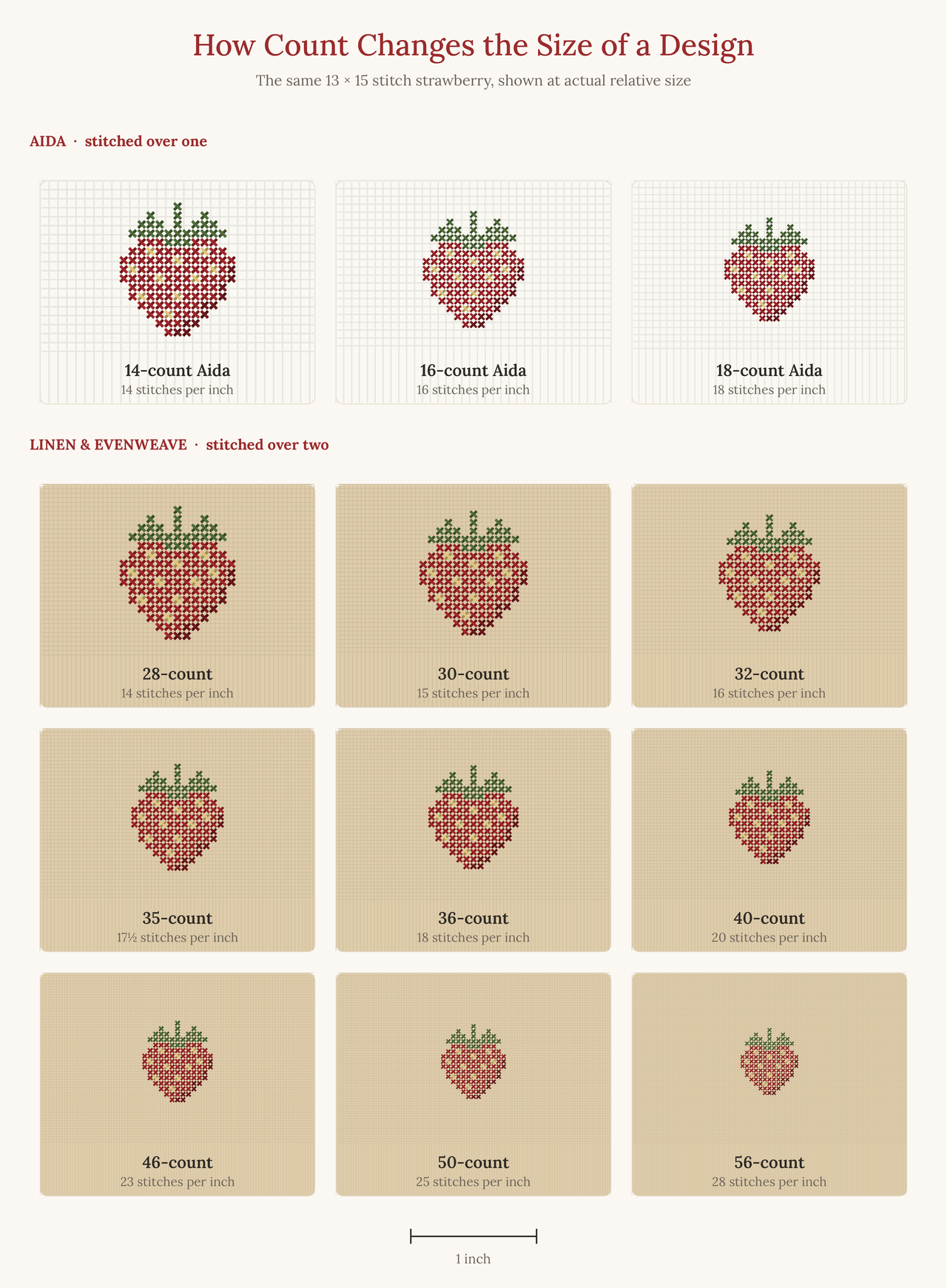
A fabric’s count is the number of threads (or squares, on Aida) in one inch. The higher the count, the finer the fabric and the smaller your finished design.
Most stitchers work over one on Aida, making one stitch per square. On linen and evenweave they usually work over two, making each stitch across two threads. That halves the count, so 32-count linen stitched over two gives you 16 stitches per inch.
Aida (stitched over one)
14-count Aida = 14 stitches per inch
16-count Aida = 16 stitches per inch
18-count Aida = 18 stitches per inch
Evenweave and linen (stitched over two)
28-count = 14 stitches per inch
30-count = 15 stitches per inch
32-count = 16 stitches per inch
35-count = 17½ stitches per inch
36-count = 18 stitches per inch
40-count = 20 stitches per inch
46-count = 23 stitches per inch
50-count = 25 stitches per inch
56-count = 28 stitches per inch
Notice that 28-count linen over two stitches up the same size as 14-count Aida. The difference is in the look and feel, not the size. At the finest counts, from 46 up to 56, a design comes out very small and delicate, much like the tiny, exquisite work on many antique samplers. It’s beautiful, but it takes good light, a fine needle, and often a magnifier.
The Three Main Fabrics
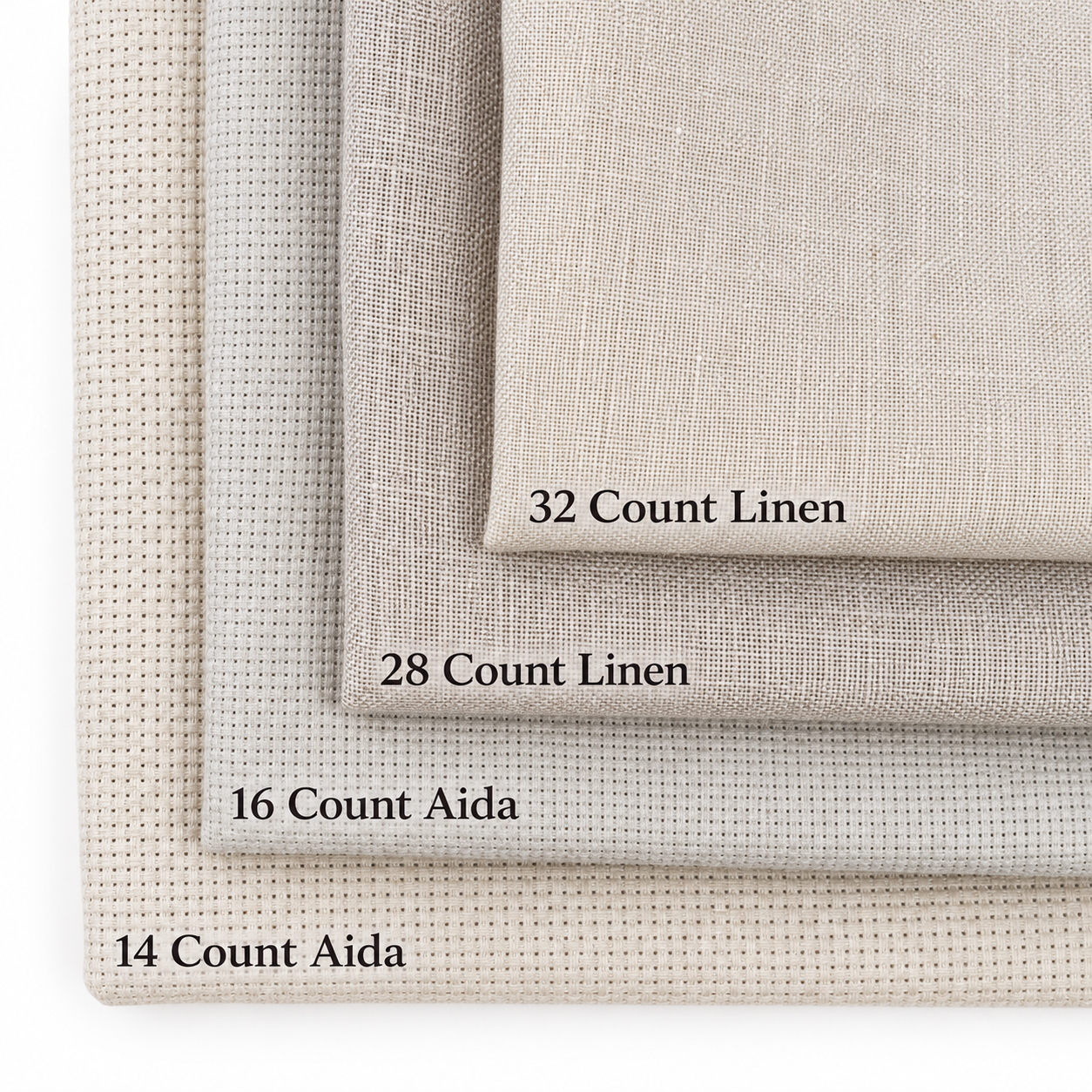
Aida is a cotton fabric woven in little blocks, with clear holes at each corner. It’s the easiest fabric to count and a good choice for beginners, children and bold modern designs. It has a crisp, even look that suits some projects well but can feel stiff next to linen.
Evenweave is woven from single threads of equal thickness, usually a cotton or cotton-rayon blend. Because every thread is the same, it’s easy to count over two, and it gives a smooth, uniform result. It’s a good step between Aida and linen.
Linen is the traditional ground for samplers and the fabric most antique pieces were worked on. It’s woven from flax, so the threads vary slightly in thickness, with small natural slubs. Those irregularities are its charm: they give a finished piece softness and depth that no other fabric quite matches. Linen takes a little more attention to count, but it rewards the effort.
Choosing a Linen Color
For reproduction samplers, color matters as much as count. Antique samplers were stitched on undyed or lightly dyed linen that has mellowed over time, so most reproductions call for a warm, aged ground rather than bright white.
Natural, flax and raw linens give the most authentic antique look.
Hand-dyed, mottled linens imitate the gentle unevenness of age and can make a new sampler feel like an heirloom from the first stitch.
Light, cream and ivory grounds suit designs with pale threads or soft pastels, which can disappear on darker linen.
Before you commit, lay your threads on the fabric in daylight. A thread that sings on one linen can vanish on another.
Before You Begin
Cut generously. Use the Fabric Calculator to find your design size, then allow room for a border and for finishing or framing.
Protect the edges. Zigzag, serge or tape the raw edges so the linen doesn't fray while you work.
Find your center. Fold the fabric in half each way and mark the center with a basting thread, then start stitching from there.
Use a frame. A scroll frame or snap frame keeps linen evenly taut and helps your stitches lie neatly.
If you’re new to linen, a 28-count is a friendly place to start. Once your eyes adjust to counting over two, the finer counts will feel natural, and you'll understand why stitchers have loved linen for centuries.